Institutional Profile
2.1. Introduction
Mid-West University (MU) is a dynamic and forward-looking institution committed to academic excellence, innovative research, and societal development. Established by the Mid-Western University Act - 2010, the University aims to transform into a leading center of excellence in higher learning in Nepal. Primarily situated in the Karnali Province, MU plays a crucial role in bridging educational gaps, fostering interdisciplinary knowledge, and contributing to regional and national progress. This section provides a comprehensive overview of the University’s institutional framework, covering its physical setting, human resources, operating technologies, academic programs, student enrollments, academic activities, financial position, key success factors, and strategic marketing propositions. 2.2. Academic Systems, Enrollment Patterns, and Human Resource Capacity
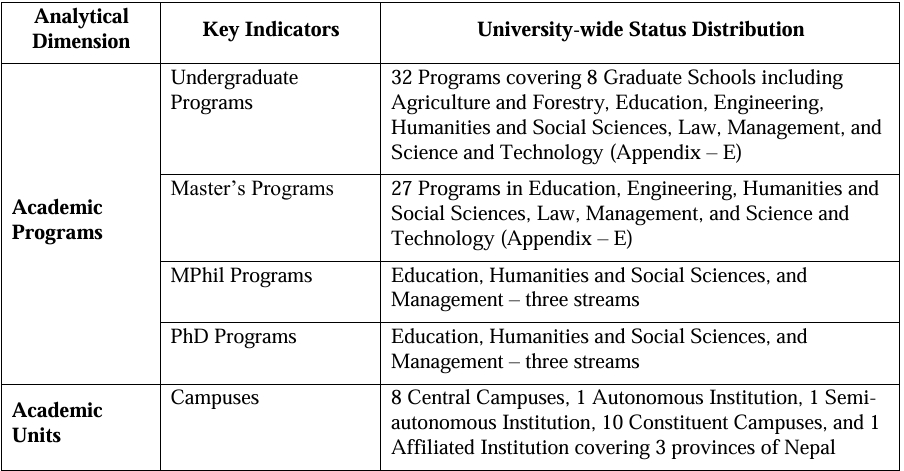
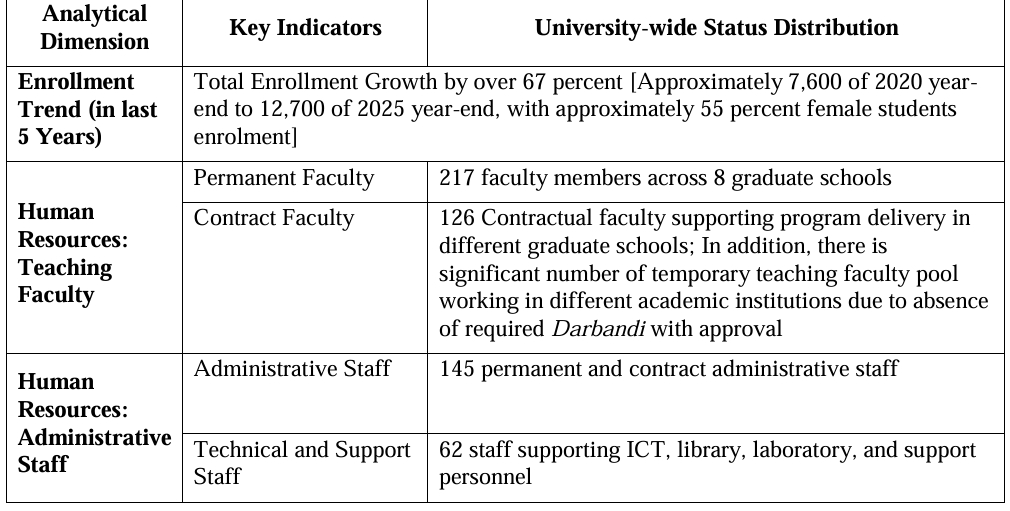
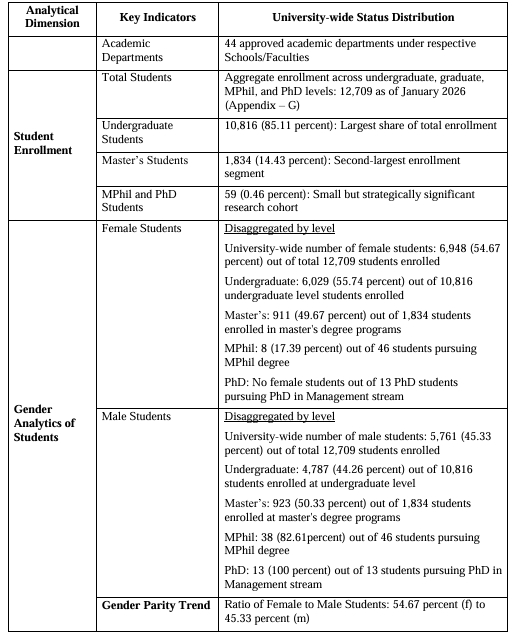
To present a concise yet comprehensive overview of Mid-West University’s institutional landscape, Table 2.1 synthesizes key academic, enrollment, and human resource analytics in an integrated format. The table captures the University’s academic program portfolio across undergraduate, graduate, MPhil, and PhD levels; the distribution of constituent campuses and academic departments; student enrollment patterns with gender and level-wise disaggregation; recent enrollment trends; and the composition of faculty and staff by employment modality. This snapshot is intended to provide evidence-based insights into the University’s scale, diversity, and operational capacity, while serving as a reference point for strategic planning, resource allocation, and institutional strengthening initiatives over the plan period.
Table 2.1: Snapshot of academic, human resource, and enrollment analytics
2.3. Physical Setting and Infrastructure
Mid-West University (MU) operates from multiple campuses strategically located across Nepal, offering a dynamic and enriching academic environment. The University’s Central Administrative Office and Central Constituent Campuses are situated in Birendranagar Municipality, Bheri Ganga Municipality, and Lekbeshi Municipality of Surkhet district in Karnali Province. These central entities cover an extensive area, equipped with modern infrastructure and state-of-the-art academic and research facilities designed to meet the highest global standards. Additionally, MU has 10 Constituent Campuses and one affiliated institution geospatially distributed across 10 districts in the Karnali, Lumbini, and Bagmati provinces, ensuring broad accessibility to quality higher education. The overall University, comprising its structural system at the head office, central campuses, and constituent campuses, owns approximately 55 hectares of land, 100 academic and administrative blocks of physical infrastructure, with a capacity to accommodate approximately 30,000 students. The University infrastructure has been meticulously designed to foster academic excellence, research, innovation, and holistic student development. The University occupies an expanse of land featuring purpose-built academic blocks, administrative offices, hostels, libraries, research centers, community halls, and student engagement zones. The architectural design of the campuses integrates sustainability and modernity, creating an ideal setting for intellectual pursuits and professional growth.
i. Classroom Setup and Learning Resource Centers:
MU takes pride in its technologically advanced classrooms, which are equipped with smart boards, interactive learning systems, and high-speed internet connectivity to support digital and hybrid learning on the University's proprietary learning management system (LMS). The University has established well-furnished lecture halls and seminar rooms that provide an immersive and engaging learning experience. Furthermore, dedicated Learning Resource Centers, Incubation Centers, Innovation Hubs, and Integrated Laboratories are set up across MID-WEST UNIVERSITY, FIVE-YEAR STRATEGIC PLAN 2082/83-2086/87 [2026-2030] Mid-West University, Nepal | Five-Year Strategic Plan | 2082/83-2086/87 |2026-2030 | 9 institutions to facilitate student-centered learning, offering access to digital and print academic resources, collaborative workspaces, and quiet study areas.
ii. Comprehensive ICT Systems and Digital Infrastructure:
A robust Information and Communication Technology (ICT) system underpins MU’s academic and administrative operations. The University provides seamless access to digital learning platforms, online databases, and e-library resources, ensuring students and faculty have the necessary tools for research and academic success. High-speed Wi-Fi connectivity is available across all campuses, enabling digital collaboration and remote learning opportunities. Additionally, the University has designed and implemented the Mid-West University Digitalization and Automation System (MU-DAS) by featuring an Enterprise Resource Planning System (ERPS), Education Management Information System (EMIS), Content Management System (CMS), and Learning Management System (LMS), and Mobile Applications of all operating systems of MU-DAS to streamline overall planning, development, and functional operations of the University.
iii. State-of-the-Art Laboratories and Research Facilities:
MU has invested in high-tech laboratories catering to various disciplines, including science and technology, environment and climate change, biodiversity, engineering, health sciences, and social sciences. These labs are equipped with cutting-edge research tools, simulation technologies, and industrystandard equipment to provide hands-on learning experiences. Innovation hubs and research incubation centers have been developed to encourage interdisciplinary research, technology-driven solutions, and entrepreneurial initiatives among students and faculty.
iv. Extensive Library and Knowledge Hubs:
The University maintains a network of wellstocked, physical and digital libraries across its campuses and departments, housing an extensive collection of basic textbooks, reference books, academic pleasure reading, research journals, periodicals, and digital repositories. The libraries are designed to foster an intellectual culture, with dedicated research zones, e-learning facilities, and reading spaces that cater to the diverse academic needs of students and scholars. MU's digital library services allow remote access to global academic resources, facilitating uninterrupted learning and research activities.
v. Sporting and Recreational Facilities:
Recognizing the importance of physical well-being and mental fitness in academic life, MU has developed comprehensive sports and recreational facilities. The University campuses include indoor and outdoor sports complexes, well-maintained athletic fields, multi-purpose courts, and gymnasiums. Students are encouraged to participate in various sports, including cricket, football, volleyball, basketball, sprint, and miler races, alongside fitness and wellness programs to promote a balanced and healthy lifestyle.
vi. Community Halls and Student Engagement Spaces:
MU’s commitment to fostering a vibrant campus culture is reflected in its well-equipped community halls and student engagement spaces. These venues host academic conferences, cultural programs, leadership training sessions, and extracurricular activities, providing students with ample opportunities to develop soft skills, network, and engage in knowledge exchange.
Through its futuristic infrastructure and innovative learning ecosystem, MU is committed to delivering a transformative educational experience that prepares students for global challenges while contributing to the socio-economic development of Nepal.
2.4 Human Capital
Mid-West University values its human capital as the cornerstone of academic excellence, innovative research, and institutional sustainability. With a workforce of approximately 600 professionals, the University leverages the expertise, dedication, and intellectual contributions of its faculty, researchers, administrators, and industry specialists to drive its mission forward.
The academic engine of the University is powered by nearly 400 faculty members, whose collective knowledge and research acumen foster an enriching learning environment. Complementing this, a team of around 200 administrative and support staff ensures operational efficiency, institutional agility, and service excellence
Recognizing the importance of continuous growth and cross-disciplinary learning, the University has cultivated strategic partnerships with national and international institutions. These collaborations facilitate knowledge exchange, resource-sharing, capacity-building, and professional mobility, strengthening the University's intellectual capital and reinforcing its position as a hub for excellence in academic and innovative research.
2.5. Operating Benchmarks
Mid-West University (MU) is committed to integrating cutting-edge technology and process innovations to enhance academic delivery, research excellence, institutional development, economic growth, and process efficiency. The University has established key operating benchmarks that drive its digital transformation and ensure a dynamic and futuristic learning environment.
One of the core pillars of MU’s technological advancement is its process digitalization and automation system, which supports online, hybrid, and blended teaching-learning and administrative operations. The overall system enables university-wide seamless data management, academic course management, interactive learning experiences, real-time assessments, leveraging administrative operating processes, and academic collaboration, ensuring flexibility and accessibility for students and faculty members alike.
To foster a data-driven research ecosystem, the University has invested in advanced computing facilities and laboratories, facilitating high-performance computing, big data analytics, artificial intelligence (AI) applications, and evidence-based policymaking. These resources empower students and researchers to engage in cutting-edge studies, leveraging technological innovations to address real-world challenges.
Operational efficiency is further strengthened through an integrated digital operating system, streamlining the management of academic and administrative affairs. This system enhances coordination between departments, automates institutional workflows, and ensures real-time access to academic and operational data, improving decision-making and institutional governance
In line with global trends and workforce demands, MU has embedded Science, Technology, Engineering, and Mathematics (STEM) Principles into the designs of its academic frameworks across disciplines and programs. The University follows a Labor Market-Driven Program (LMDP) Framework, ensuring that curricula across graduate schools and academic programs remain relevant, skills-oriented, and aligned with industry needs. This approach bridges the gap between academia and the job market, equipping graduates with practical competencies and interdisciplinary expertise required for career success.
Through these operating benchmarks, MU continues to evolve as a futuristic, technologically advanced, research-intensive, and student-centered institution, fostering innovation and excellence in higher education.
2.6. Academic Programs
MU offers a diverse and dynamic range of academic programs at undergraduate, graduate, and doctoral levels across multiple disciplines, designed to meet the evolving needs of students, industries, and society. With a strong commitment to academic excellence, research, and professional development, MU provides a comprehensive learning environment that fosters innovation, critical thinking, and leadership. Out of 90 approved academic programs, the University has been offering 59 academic programs including all levels of study.
MU offers specialized programs in Agriculture and Forestry, equipping students with modern agricultural techniques, sustainable farming practices, agro-economics, and forest resource management. These programs integrate research and field-based learning to address food security, environmental sustainability, and rural development challenges.
The University’s Education programs prepare future educators, administrators, and policymakers with the knowledge and pedagogical skills required for effective teaching, curriculum development, and educational leadership. Programs focus on primary, secondary, and higher education, incorporating contemporary teaching methodologies and educational research.
MU provides Engineering, Science, and Information Technology programs that cater to the demands of the digital and industrial era. Disciplines include Civil Engineering, Computer Engineering, Basic and Natural Sciences (Environmental Science, Physics, Chemistry, and Mathematics), Computer Science, Artificial Intelligence, Big Data Analytics, Cybersecurity, and Global Media integrating theoretical knowledge with practical applications in cutting-edge laboratories. These programs emphasize research, innovation, and practical applications in solving contemporary technology, engineering, and scientific challenges.
The Humanities and Social Sciences programs specialize in Sociology, Anthropology, Political Science, Development Studies, Media Studies, and International Cooperation and Development fostering analytical and research skills essential for understanding societal transformations, governance, and public policy.
MU’s Law programs aim to develop legal professionals with expertise in constitutional law, human rights, corporate law, and international law. The curriculum emphasizes legal research, critical reasoning, and policy advocacy to prepare graduates for careers in legal practice, judiciary, academia, and governance.
MU provides a robust portfolio of Management and Business Administration programs, designed to nurture future business leaders, entrepreneurs, and financial experts. Key specializations include Entrepreneurship and Innovation, Agribusiness, Accounting and Finance, Digital Marketing, Integrated Marketing Communications (IMC), Management of Banking and Financial Institutions, Human Resources Management, Public Administration and Governance, Management of Non-Profit Organizations, and Management of Tourism and Hospitality.
As part of its long-term vision to become a multidisciplinary center of excellence, Mid-West University plans to expand its academic portfolio to include programs in Health Sciences related areas such as Medicine, Nursing, Public Health, Biotechnology, Policy Studies etc. These upcoming programs will be designed to address the growing demand for healthcare professionals, medical researchers, and public health experts, particularly in Nepal and beyond. The Medicine and Nursing programs will focus on developing highly skilled healthcare practitioners equipped with both theoretical knowledge and hands-on clinical training. The Public Health program will emphasize preventive healthcare, epidemiology, and health policy, contributing to national and global health systems. Additionally, the Biotechnology program will foster cutting-edge research in genetics, bioengineering, and pharmaceutical sciences, driving innovations in healthcare, agriculture, and environmental sustainability. In addition, the University is expanding its academic offerings with specialized Policy Studies programs focusing on evidence-based policymaking, governance, and public administration to develop professionals capable of shaping national and international policies. By integrating modern technology, industry collaborations, and international academic partnerships, MU aims to establish itself as a leading institution in medical and life sciences education, fostering a new generation of professionals committed to societal well-being and scientific advancement. Through its diverse academic portfolio, MU remains committed to fostering interdisciplinary learning, research excellence, and global engagement, equipping students with the skills and knowledge needed to thrive in an ever-evolving world.
2.7. Student Enrollments The University follows a structured, merit-based, and socially inclusive admission process designed to attract talented students from diverse backgrounds while aligning with national priorities in education. The University is committed to ensuring equitable access to higher education and fostering a learning environment that reflects Nepal’s rich social, cultural, and geographic diversity.
MU offers annual and bi-annual admissions across its undergraduate, graduate, and doctoral programs, ensuring flexibility for prospective students. The admission process varies by program but maintains a rigorous and transparent selection approach to uphold academic excellence. Compared to last five years, ranging between 7,000 to 13,000 students annually are pursuing higher education spanned over 59 academic programs. Aggregate enrollment has been increased by above 67 percent in the last five years.
In line with its commitment to Gender Equality, Disability, and Social Inclusion (GEDSI), MU implements a quota-based system for admission in its technical academic programs and an open system for general academic programs. Both the system practices prioritize students from underprivileged backgrounds, ethnic minorities, persons with disabilities, and those from remote and marginalized regions. This system ensures that education at MU remains accessible to all, regardless of socioeconomic status, physical ability, or geographic constraints. Special provisions, including scholarships and financial aid, are also available to support these students.
Mid-West University adopts a differentiated and multi-tiered admission approach, integrating various assessment methods to ensure a holistic evaluation of applicants. The selection process includes assessment of subject knowledge, analytical skills, and aptitude through entrance tests; performing a comparison of past academic achievements and consistency; and gauging motivation, leadership potential, and alignment with program objectives.
Looking ahead, MU aims to enhance its student outreach programs, expanding access to talented students through digital application systems, bridge courses for marginalized communities, and partnerships with schools and local governments to promote higher education opportunities. Additionally, the University plans to introduce international student exchange programs to foster cross-cultural academic experiences and global learning opportunities.
By integrating merit-based selection with a strong commitment to social inclusion, MU ensures that its student body is diverse, talented, and equipped to contribute meaningfully to academia, industry, and society.
2.8. Academic Activities
Mid-West University fosters a dynamic and intellectually stimulating academic environment through a diverse range of scholarly, research, and experiential learning initiatives. These activities are designed to enhance critical thinking, professional development, and innovation while ensuring that students and faculty remain engaged in cutting-edge academic discourse. MU integrates theory with practice, enabling learners to gain hands-on experience and contribute to their respective fields through research, collaboration, and knowledge-sharing platforms. More recently, the overall academic programs of the University offered through different graduate schools have been undergoing a thorough paradigm shift by redesigning them under labor marketdriven program (LMDP) framework induced by the University Grants Commission (UGC).
MU regularly organizes thematic workshops and expert-led seminars across various disciplines to facilitate knowledge exchange, professional development, and skill enhancement. These sessions feature renowned scholars, industry experts, and policymakers, providing students and faculty with insights into emerging trends, global best practices, and industry demands.
The University actively promotes a research-driven culture by hosting national and international conferences that bring together academics, researchers, and professionals from diverse fields. These conferences serve as platforms for presenting research findings, fostering interdisciplinary collaboration, and driving innovation in science, technology, business, social sciences, and policy studies.
MU emphasizes experiential learning by integrating fieldwork, case studies, and practical experimentation into its academic curriculum. Students engage in on-site research, industry visits, and community-based projects, gaining hands-on experience and practical problem-solving skills in real-world settings.
MU is equipped with state-of-the-art laboratories and research centers that support advanced scientific inquiry, technological innovation, and experimental learning. These facilities enable students and faculty to conduct high-quality research in fields such as biotechnology, environmental science, engineering, information technology, and health sciences, contributing to knowledge creation and technological advancement.
As part of its commitment to evidence-based policymaking and governance, MU has established the MU Policy Lab, which serves as a think tank for conducting policy research, governance studies, and social innovation projects. This initiative encourages faculty and students to engage in policy analysis, public sector research, and interdisciplinary collaborations, ensuring that MU remains a hub for thought leadership in public administration and governance.
MU is continuously expanding its academic activities by introducing collaborative research projects, interdisciplinary innovation hubs, digital learning platforms, and international academicpartnerships. The University aims to position itself as a center of excellence for knowledge generation and application, empowering students and faculty to lead in their respective fields.
By integrating academic rigor with real-world engagement, MU ensures that its academic activities contribute to personal, professional, and societal growth, reinforcing its mission to foster intellectual excellence and social transformation.
2.9. Financial Resourcin
The University strives for maintaining a sustainable and resilient financial structure to ensure longterm growth, operational stability, and academic excellence. The University strategically diversifies its revenue streams to support its educational mission, research initiatives, and institutional development while ensuring affordability and accessibility for students. The University's financial sourcing model is structured around the following key components:
i. Government Funding: MU receives primary financial support from the federal government, reflecting the institution’s strategic role in advancing higher education, research, and innovation in Nepal. This funding covers infrastructure development, salary and benefits to the teacher-staff, research facilitation, and student support services, ensuring the University’s core operational stability. Provincial and local governments also provide needs-based financial support on common interests of academia, policy advocacy, and innovative research.
ii. Grants for Research and Development: The University actively pursues competitive national and international grants for research and development to strengthen its research ecosystem and institutional system capacity. These grants are secured from government agencies, multilateral institutions, academic foundations, and development organizations, enabling MU to undertake cutting-edge research, community-based projects, and policy studies that contribute to national and global knowledge.
iii. Tuition Fees: MU maintains a balanced and affordable fee structure to ensure that higher education remains accessible to students from diverse socio-economic backgrounds while maintaining high academic standards and quality service delivery. The University also offers scholarships, financial aid, and fee waivers to support meritorious, underprivileged, and marginalized students.
iv. Endowments and Strategic Partnerships: MU fosters long-term financial sustainability through endowments, strategic partnerships, and collaborative funding models. The University actively engages with industry leaders, development partners, private sector stakeholders, development partners, and philanthropic organizations to mobilize financial resources for academic programs, research, innovation, and community outreach.
v. Others: Other fringe sources of revenue collection to the University include contribution into University Development Fund from the specific project bids won by different entities and work teams within the University, earnings from academic events, institutional consultancy services, bank interests, and other unforeseen contingent receipts.
Through this diversified financial strategy, MU ensures continuous institutional growth, infrastructure expansion, research excellence, and enhanced student services, positioning itself as a financially resilient and forward-thinking academic institution.
2.10. Key Success Factors and Marketing Propositions
The University's continued growth, national recognition, and global positioning are driven by a combination of strategic advantages, academic excellence, and strong institutional values. The University distinguishes itself through the following key success factors and value propositions:
i. Commitment to Academic Excellence: MU upholds high academic standards through innovative teaching methodologies, rigorous curricula, and a strong research focus. The University’s defined policy and program-based commitment to faculty development, interdisciplinary learning, and applied research and innovation ensures that students receive a holistic and globally competitive education.
ii. Strategic Location and Regional Impact: Primarily situated in the Karnali Province of Nepal, MU serves as a leading center for higher education in Nepal’s remote yet rapidly evolving region. The University plays a pivotal role in regional development, addressing local socio-economic challenges through education, research, and policy engagement. Historically, Karnali maintains a prestigious position in knowledge economy, MU has potential to reposition this identity as one of the strategic instruments for transforming success through innovation and market reach.
iii. Industry and Community Engagement: MU maintains strong linkages with industries, government agencies, and local communities, ensuring that its academic programs are aligned with labor market demands and societal needs. The University collaborates on joint research projects, internship programs, skill-based training, and policy advisory services, enhancing student employability and real-world impact. Local and provincial government participation and stewardship in institution building, academic programs development and implementation, incubation, research and innovation, has already been institutionalized by the University. Establishment of Graduate School of Engineering Central Campus at Sano Surkhet, and Graduate School of Agriculture and Forestry Central Campus at Bheriganga Municipality and Lekbeshi Municipality reveal transformation of such cooperation.
iv. Global Collaborations and Academic Mobility: MU actively fosters international partnerships with renowned universities, research institutions, and global networks. These collaborations support student and faculty exchange programs, joint research initiatives, dual-degree programs, and cross-border knowledge-sharing, enhancing the global presence of the University. For example, as of December 2025, MU has signed memorandum of understanding (MoU) with at least 130 institutions across the world to initiate strategic and program level collaborations. Ast least 33 such collaborative arrangements with national and international governments, institutions, and agencies are in active status as of December 2025.
v. Digital Transformation and Technological Innovation: MU integrates smart technologies and digital tools into its academic and administrative operations. The adoption of Mid-West University Policy, Strategy, and Plan of Action, 2024 on University Digitalization and Automation serves as a strategic pathway to University transformation through meaningful systemic as well as operational digitalization and automation. Implementation of learning management systems (LMS), AI-driven research methodologies, big data analytics, and virtual classroom systems enhance teaching-learning experiences, research and innovation activities, and student engagement – all resulting in institutional efficiency.
vi. Social Responsibility and Inclusive Education: MU is committed to contribute meaningfully into evidence-based social equity, environmental sustainability, and community service. The University prioritizes inclusive education policies, ensuring equal opportunities for women, persons with disabilities, ethnic minorities, and students from underprivileged backgrounds. Through its GEDSI Framework (Gender Equality, Disability, and Social Inclusion), green initiatives, and community-based projects, MU positions itself as an institution that contributes to societal transformation.
By leveraging these key success factors, MU continues to expand its academic influence, drive research innovation, strengthen global collaborations, and contribute to Nepal’s educational and economic progress, reinforcing its reputation as a leading institution of higher learning in South Asia.
2.11. Conclusions
In conclusion, this section has outlined the vision for the institution's continued evolution as a leading institution in the landscape of higher education, research, and societal impact. With a firm commitment to academic excellence, the plan articulates an ambitious roadmap for positioning MU as a global center of innovation, embracing the demands of an increasingly interconnected and technologically advanced world. The University's strategic approach centers on harnessing its unique regional strengths in Karnali Province while expanding its global reach, ensuring that its educational offerings are both relevant and transformative.
Central to this vision is the integration of cutting-edge technologies, including artificial intelligence, big data, and the Internet of Things, which will be woven into curricula and research to enhance both academic delivery and societal contributions. The plan places significant emphasis on building smart, sustainable infrastructure, ensuring that MU remains at the forefront of technological advancement while also addressing the region's socio-economic needs. By embedding green initiatives into every aspect of its operations, MU will not only lead in academic excellence but also foster a culture of environmental stewardship and long-term sustainability.
In addition, the strategy outlines the establishment of robust, interdisciplinary partnerships with national and international institutions, facilitating the exchange of knowledge, research, and resources. These collaborations will serve as a catalyst for innovation, expanding the University's academic and research capabilities. Through these alliances, MU aims to increase its global visibility and influence, solidifying its position as a forward-thinking institution that addresses the most pressing challenges of our time.
A key takeaway from this section is the competitive positioning of MU in the higher education sector, particularly in Nepal’s federalized academic landscape. The analysis underscores the opportunities for growth in areas such as digital transformation, quality assurance, accreditation, international partnerships, and specialized academic offerings. The University's distinct advantage lies in its geographical presence in Karnali Province, where the demand for higher education, research-driven policymaking, and workforce development continues to grow.
To ensure that these transformative initiatives are effectively realized, the plan sets forth rigorous performance metrics and a framework for continuous assessment. This strategic oversight will guide the University's efforts in addressing its key challenges, such as financial sustainability and workforce development, while leveraging its strengths to foster growth and innovation. Through this comprehensive strategy, Mid-West University is poised to reshape the future of education, driving meaningful societal change and contributing to the global knowledge economy.